
Few natural landmarks command attention quite like Victoria Falls.
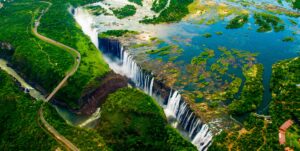
Stretching across the border between Zimbabwe and Zambia, the massive waterfall is one of southern Africa’s most recognizable natural features. But beyond its scale and beauty, Victoria Falls sits within an environmental landscape that raises much larger questions about conservation, biodiversity, public policy and the relationship between people and natural resources.
Those questions will become reporting assignments for TCU journalism students studying in Victoria Falls, Zimbabwe, in summer 2027.
The program is co-led by Professor Uche Onyebadi and Jean Marie Brown, associate professor of professional practice and director of student media, with support from the Sandusky Globalization Fund for Journalism. The Public Affairs Journalism program will place students at the intersection of environmental policy and international reporting, using Zimbabwe’s efforts to restore and protect its wetlands as the central reporting subject. Students will examine how governments, international agencies, scientists and communities work together, and sometimes at odds, in shaping environmental policy.
Victoria Falls is part of the Zambezi River system and a landscape where water shapes ecosystems, wildlife, tourism and surrounding communities. Its significance also extends beyond the waterfall itself to the wetlands and habitats that sustain the region.
That makes Zimbabwe an especially timely place to study environmental reporting.
“Since 1970, 30 percent of the world’s wetlands have been lost to degradation and human development,” Brown said.
In 2025, Victoria Falls hosted the 15th Meeting of the Conference of the Contracting Parties to the Convention on Wetlands, drawing international attention to wetland conservation and the challenges facing freshwater ecosystems worldwide.
Zimbabwe has committed to restoring 250,000 hectares, or approximately 617,763 acres, of degraded wetlands by 2030. The country is also working toward establishing five new Ramsar Wetlands of International Importance, a designation recognizing wetlands with global significance for biodiversity and humanity.
Reporting with an Impact
For student journalists, that work provides an opportunity to move beyond discussing environmental policy in a classroom and instead report from a place where those policies are being put into practice.
The waterfall provides a powerful starting point. Its presence illustrates how closely water, wildlife, tourism, economic activity and conservation can be connected. Students can see the landscape they are reporting on, speak with the people responsible for protecting it and examine how environmental decisions affect communities and ecosystems.
Conservation efforts in the region extend well beyond wetlands. Nongovernmental organizations are working throughout Zimbabwe and the greater Zambezi region on issues including biodiversity, wildlife protection and sustainable development.

That reporting will introduce students to organizations working across environmental management and wildlife conservation in Zimbabwe. Program materials identify potential reporting opportunities involving the Environmental Management Agency, Zimbabwe Parks & Wildlife Management Authority, International Fund for Animal Welfare, BirdLife Zimbabwe and Victoria Falls Wildlife Trust.
Those organizations provide students with a network of potential sources and perspectives that illustrate the complexity of environmental reporting. Conservation is not simply a story about protecting a landscape. It can also involve government policy, tourism, economic development, local communities, international organizations and competing ideas about how natural resources should be managed.
“The primary objective of this study abroad is to provide students with topics and sources to build a report on the work being done in Victoria Falls,” Brown said.
Students will be expected to report much as professional journalists would, gathering perspectives from government officials, nongovernmental organizations and visitors to Victoria Falls. They will also practice real-time social media reporting while abroad.
“Students will have the opportunity to report in real time,” Brown said. “They will be doing live reporting on social media with video and photographs. They will be interviewing officials from the government, non-governmental organizations, as well as visitors to Victoria Falls. This will allow them to do higher-level reporting than can be found on campus.”
Real-Time Multi-Platform Reporting
That reporting will stretch across platforms. Students will build their reports using written journalism alongside digital elements that may include photography, slideshows, video, audio and maps. They will also develop social media content to amplify their work and participate in a TCU 360 Instagram takeover while traveling.
The experience is designed to challenge students to think beyond a traditional written story. Reporting on an environmental issue as complex as wetland restoration or wildlife conservation requires journalists to determine not only what information matters, but also which medium can communicate it most effectively.
 Photography and video can document the landscape and wildlife. Interviews can introduce the people responsible for conservation efforts, while written reporting can provide the policy, history and context necessary to understand what is at stake.
The setting also introduces another layer to the experience: students will be reporting internationally.
They will have to develop sources and quickly build an understanding of issues they may have previously encountered, relying solely on research. Instead of relying solely on reports and secondary sources, they will be able to observe the environment and speak directly with government officials, conservation organizations and people visiting or working around Victoria Falls.
Their reporting will ultimately contribute to a story examining the wetlands of Victoria Falls and Zimbabwe’s efforts to restore and protect them.
That experience can reshape how students understand both journalism and the issues they cover.
‘More Than a Backdrop’
“I hope they walk away with a broader understanding of how to approach public policy journalistically and the knowledge to tell stories across a range of platforms in real time,” Brown said. “I hope this broadens their worldview and deepens their understanding of the global community.”
Victoria Falls offers a dramatic backdrop for that lesson, but the waterfall is more than the backdrop.
It is an entry point into understanding the environmental systems surrounding it and the efforts underway to protect them. As Zimbabwe works to restore wetlands, preserve biodiversity and balance conservation with economic and human needs, students will have an opportunity to witness those conversations as they unfold.
Read more about the study abroad program.
About the Sandusky Fund
The Sandusky Globalization Fund for Journalism was established in 2017 by Sue Ann Sandusky, who graduated from TCU in 1974 with a double major in Journalism and Government, to enable the Bob Schieffer College of Communication and its Department of Journalism to help students develop global awareness and competency. During more than 30 years of active U.S. Army service, Col. Sandusky was stationed in Bosnia, Croatia, Germany and the Republic of Korea, and served multiple tours as defense attaché at U.S. embassies in Cote d’Ivoire, Democratic Republic of Congo, Liberia and Nigeria. As an avid traveler, she canoed the Zambezi River and amassed an extensive collection of African art.