
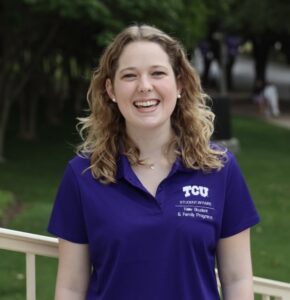
 Ellie Griffin built her college career around one idea: using her voice to advocate for others.
As a John V. Roach Honors student and double-major in journalism and theater, Griffin has spent her time at TCU across disciplines. From the Schieffer College of Communication to the College of Fine Arts, she curated a college experience that reflects both her academic and personal interests.
“TCU caters to all of those interests,” she said. “So that’s been really great for me.”
Her involvement extends beyond campus.
A Commitment to Serving
While Griffin has been involved in numerous campus organizations, one role stands out as especially meaningful: her work with CASA.
“CASA stands for court-appointed special advocate,” she said. “CASA advocates volunteer with kids in foster care and essentially represent them in court by speaking on their behalf and in favor of their best interest.”
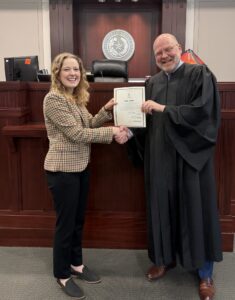 Her interest began during a summer internship in Georgia, where she first encountered the organization.
“I don’t know how to explain it other than to just say that I really fell in love with it,” Griffin said.
The reason, she said, is simple.
“Because I think that everybody deserves a voice.”
After turning 21, Griffin completed the required training and became a CASA volunteer in Tarrant County. She has since closed one case and is currently working on two others.
“And that one had a happy ending, which is always super exciting to see,” she said.
Research and Real-World Impact
Griffin’s academic work extended beyond the classroom into research, particularly in media law and emerging technologies. Working with journalism professor and assistant provost for research compliance Daxton “Chip” Stewart, she contributed to a study examining artificial intelligence, social media and their legal implications.
“I fell in love with the material,” she said. “I also fell in love with the way he teaches and how invested he is in his students. He makes sure that anyone who wants to talk gets to talk. And so, after that class wrapped up, I approached him and said, ‘Hey, I really enjoyed your class. If you ever need any help with research, I would love to help.’ I didn’t think he would say yes,’ but he did!”
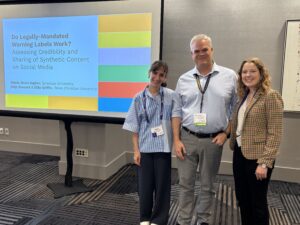
What began as a simple outreach turned into a significant academic opportunity. Griffin was credited as a third author on the study and presented the research at the Association for Education in Journalism and Mass Communication Annual Conference (AEJMC).
She later built on that experience through an independent study exploring the legal implications of artificial intelligence in cases involving vulnerable populations.
From Undergrad to Law School
After graduation, Griffin will attend Baylor Law School, where she was awarded the Leon Jaworski Scholarship for Outstanding Undergraduate Advocates.
The scholarship is awarded to one or two incoming law students each year with strong backgrounds in advocacy programs such as debate or mock trial.
“That was a really, really big win for me. Kind of the cherry on top for all the work that I have put in over these years,” she said.
As she looks ahead, Griffin hopes to continue working with vulnerable populations, particularly children and women in difficult circumstances.
“I would love to be an advocate for kids,” she said. “I also would really love to work with women in situations of domestic violence.”
Balancing It All
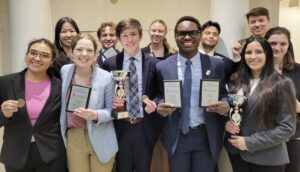
In addition to her coursework, volunteering, and research, Griffin serves as president of the TCU speech and debate team, after previously serving as vice president and administrative assistant. She also worked as a copy editor for the Skiff, participated in theater productions and worked in the costume studio. Maintaining a demanding schedule while staying academically successful requires discipline and prioritization.

“I think it’s definitely a lot of diligence and also understanding that grades come first,” Griffin said.
She credits a lesson from one of her professors as a guiding principle.
“Almost 100% of the game is just showing up and not fumbling the ball,” she said.
 That mindset has shaped how she manages her time, particularly when balancing multiple commitments.
“I think there’s a value in saying no and in setting boundaries, especially when it comes to your time,” she said.
“If you can halfway commit to 40 different tasks, don’t do that when you can fully commit to 10. I think that’s been one of the biggest challenges for me – learning to set those boundaries and learning where my priorities lie.”
Through her work in the classroom, the courtroom and the community, Griffin has already begun building the foundation for that future – one rooted in service, advocacy and a commitment to making sure others are heard.