

Cassandra Hayes, Assistant Professor of Journalism
As coverage of things like the Super Bowl dominate the national sports media, rodeos across rural America are constant … and growing. Whether it’s rodeos hitting big cities or the ongoing Friday night circuit, Western culture is trending, and the sport of rodeo is experiencing a surge. With that comes growing media coverage.
Cassandra Hayes, assistant professor of journalism, says that this news coverage stands to frame public perception of rural life.
“Often, rural life appears in stories about rodeo in a way to signal ‘authentic roots,’ some sort of connection to hard work and continuation of past traditions,” Hayes said. “So, rodeo journalism recenters rural life as a central element of ‘authentic’ culture and identity — especially in the U.S., Mexico and Canada, countries in which the frontier plays a mythic and historic role in identity formation and the sense of the place.”
She sat down to explain her research, recently published in the Southwestern Mass Communication Journal, “Yee-Haw Newsworthiness: How Rodeo Journalism Frames Rural Identity.”
Why do dominant frames such as Western pop culture, nostalgia and conflict matter in shaping public understanding of rural communities?
I think a great example of the importance of rodeo story framing for rurality is the discourse (in journalism and within the public) about Beyonce’s Cowboy Carter album. During the 20th century, with increased urbanization of both media and society at large, rural identities became alienated and stereotyped, broadly, within mainstream news — to the extent that popular understanding of what it means to be rural meant only one very limited thing (behind the times, not progressive, not interested in cultural evolutions, not relevant to urban folks, etc.). But in truth, rural communities are highly diverse, both internally and between communities, and carry continued implications for even urban-based individuals/communities. Beyonce’s album challenged many mainstream assumptions about rurality and what it means to be “country” by putting a Black woman hip-hop artist — and native Texan — at the center of media framing about rodeo and rural life. News stories about this album and her performances at the Houston Livestock Show and Rodeo exposed the shallowness of stereotypes about rurality and showed that rurality is actually central to the cultural identity of a wide range of people. The Fort Worth Stock Show & Rodeo is also a great example of this, due to the legacies of Cleo Hearn, Bill Pickett and others who broke racial barriers in the sport of rodeo.
How do journalistic news values determine which aspects of rodeo and rural life are elevated or overlooked?
A common saying within journalism is that it is “the first draft of history.” This means that journalism provides the first public sense of meaning for current events and conversations, guiding later interpretations of the happenings of the day. News values such as proximity, timeliness, conflict, impact, etc. are used by journalists to determine what is noteworthy enough to be included in this “first draft.” Thus, decisions of newsworthiness always are limited, context-dependent decisions to overlook some things in order to elevate others. Rodeo news stories frame rural life as (a) important for a sense of communal identity connected to the past and (b) connected to, at times, sensationalized violence. That’s because “proximity” of the topic to the journalism outlet’s market and “conflict” are established news values. Focusing on these frames does elevate more complexities of rural life than typically included in non-rodeo news overall. However, it is important for rodeo journalists to keep in mind the limitations of only including rurality in a context of violence and connections to the past.
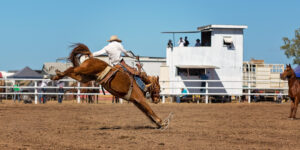
A cowboy riding a bucking bronc horse in a rodeo competition.
What are the consequences of these framing choices for rodeo as a sport that remains widely followed yet under-studied?
Rodeo is fun to study for a journalism scholar because a lot of the “rules” found for media coverage of other sports, such as American football, baseball, boxing, etc., just don’t apply to this sport. Namely, rodeo journalism remains regional and local, rather than the national “spectacle” sports coverage typical for most other American sports these days. It’s hard to remove the romanticized connection to rural life from rodeo stories, as rurality is a central part of practically understanding the sport. For instance, the typically “rural” (on some level) locations where both human and livestock athletes are based are central to telling their stories and evaluating their performances. That’s important because generational connection is a really practical reality of the sport — the breeding of the livestock, who owns and cares for (and sponsors) the livestock, in addition to a lot of familial connections between human athletes. Not including rural life in news stories about rodeo would be a misrepresentation of what this sport is. Sometimes sports coverage of rodeos (and especially Professional Bull Riding events) frame it as a “niche sport,” something along the lines of skateboarding or monster truck racing. In reality, that’s inaccurate and further overlooks the continued centrality of rural life to overall cultural identity. It just further perpetuates marginalization of rural voices in mainstream media — leading to rural people understandably feeling alienated and distrustful to journalism.
How might repeated framing patterns in rodeo coverage contribute to the marginalization of rural voices within journalism?
Rodeo presents the opportunity for journalists, with their established news values, to include rural representation in mainstream news media. However, framing patterns do run the risk of oversimplifying complex groups and places, if not used with sensitivity to nuance. For instance, emphasizing violence within rodeo is common in news stories and leads to misconceptions about rural life, as well. At a Fort Worth Stock Show & Rodeo event, for instance, you’ll hear the announcers discuss the high regard livestock athletes are held with, within rodeo culture — livestock athletes are respected as autonomous beings with extreme talent and strategy of their own, connected to a place and very hardworking, scientifically knowledgeable people. Just like human athletes in all sports. Yet news stories that only report when a bull maims someone, or only report when animals are injured by accident or outside of officially sanctioned rodeo events, perpetuate the myth that rural folks don’t care about who they hurt with their actions, torture animals, are ignorant to healthily caring for living creatures, etc. Which just isn’t true if you actually talk to people. As with any topic and group of people, journalists need to be careful that, in their presentation of “the first draft of history,” they are doing their due diligence to fully represent the actual experiences of the people they are covering. They shouldn’t just get caught up in what makes a newsworthy story and include stuff just for inclusion’s sake, without considering context.