
This year, Texas Christian University’s Pi Kappa Delta chapter marks 100 years of excellence in speech and debate.
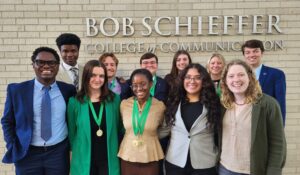
TCU Speech and Debate Team (2025-2026) pose in front of the Bob Schieffer College of Communication.
For Amorette Hinderaker, convener of debates and associate professor of communication studies, the centennial celebration carries special meaning. Not only does it mark a century of the university’s Pi Kappa Delta chapter, but it also coincides with her 10th year serving on Pi Kappa Delta’s National Council. This past year, Hinderaker has served as national president during the organization’s 100th anniversary.
Bringing Speech and Debate Back to TCU
Hinderaker’s connection to the program runs deep. When she arrived at TCU in fall 2012, the speech and debate team had been inactive for decades. The team’s last year of activity was 1977, leaving a nearly 35-year gap without formal competition at the university.
“Speech and debate feeds that activity of creating global citizens,” she said. “To watch them grow and learn is such a rewarding and humbling experience.”
The effort was about more than restoring a campus tradition; it was also about reconnecting to a rich legacy of debate in Texas. TCU has a historic place in that story: in 1935, it became the first all-white college in the South to host the historically Black Wiley College debate team. This landmark, non-segregated debate in Fort Worth was a groundbreaking moment for interracial dialogue in the region and highlighted the power of debate to challenge social norms. Wiley College’s debate team later inspired the 2007 film: The Great Debaters, which chronicled the team’s victories and the larger significance of speech and debate in shaping civic engagement and social progress.
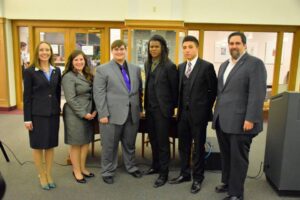
TCU vs Wiley, Commemorative Debate to commemorate the 80th anniversary of the first interracial intercollegiate debate on a Southern U.S. college campus at TCU, 1935.
Determined to rebuild the program, Hinderaker spent her first year rebuilding it from the ground up. With support from the university and from Nowell Donovan, Charles B. Moncrief chair of geology and provost emeritus, who helped establish the University Debate Chamber in Scharbauer Hall, she laid the foundation for a new era of competitive debate at TCU.
By fall 2013, TCU’s speech and debate team was back on the competition circuit, carrying forward both a revived program and the university’s historic legacy of bold, boundary-crossing debate.
Tradition Meets a New Generation
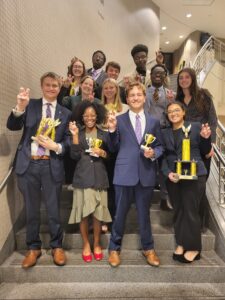
TCU Speech and Debate Team (2025-2026) posing with their trophies from competition.
Today, the program continues to grow through a selective audition process. Only 15 students are chosen to join the team each year, practicing several days a week as they prepare for tournaments.
For Hinderaker, the experience is about far more than competition.
Students from across the university participate, bringing a wide range of perspectives to the team. Competitors come from majors in religion, engineering, journalism, theater and many other disciplines. Many alumni go on to careers as high-level attorneys, business owners or future educators on the university level.
Learning the Ropes Through Competition
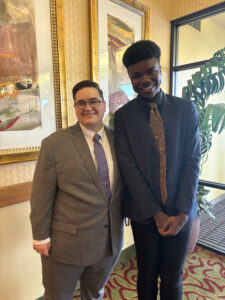
Timothy Betts (left) and Ellington Holkmann (right) pose together during a Pi Kappa Delta event.
Freshman journalism major Ellington Holkmann is one of the newest members experiencing collegiate speech and debate for the first time. Coming into the program with no previous experience, Holkmannsaid learning how competition works has been the biggest challenge.
“The most challenging part of competing has been learning the rules and how to ‘play the game,’” Holkmann said. “I came in with close to zero experience with debate and limited background in preparing speeches, so I had to learn both the rules and regulations for all the different events as well as the norms and expectations socially.”
Despite the learning curve, Holkmann said the team’s mindset has helped him stay grounded.
“Our team’s motto is ‘Why are we the only team having fun?’” he said. “The different competitions we go to are only as competitive as you make them, and it’s easy to stress yourself out comparing yourself to other people, so it’s important to remember to enjoy yourself too.”
Leadership Lessons from the Debate Floor
For senior journalism and theater double major Ellie Griffin, however, the journey is coming full circle.
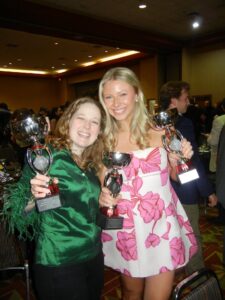
Ellie Griffin (left) and Natalie Pelan (right) celebrate their national championship victories at the Pi Kappa Delta National Tournament.
The John V. Roach Honors student has been part of the team since her first year at TCU and has competed since her freshman year in high school. As the team’s president during the chapter’s 100th anniversary, she says the milestone makes the year especially meaningful.
“First and foremost, it’s an honor to even get to be president of the team,” Griffin said. “With the added layer of the 100th anniversary, it has been a special year for me.”
After years of competing, Griffin says the most important lesson she has learned is to value the experience over the outcome.
“Trophies are just a hunk of plastic,” she said. “In the long run, it doesn’t matter how many rounds you win or lose. The older I get, the more I have learned to value the process over the product.”
Senior Natalie Pelan, a communication studies and political science double major and the team’s vice president, joined the program in her second year at TCU and will graduate early, making this her second and final season competing with the team.

Amorette Hinderaker (left) and Natalie Pelan (right) pose together during a Pi Kappa Delta National Tournament.
Pelan says one of the most valuable skills she has developed through speech and debate is the art of persuasion.
“Learning how to formulate a valid argument and justify it with evidence — in only 30 minutes — is something that takes practice,” Pelan said. “Continuing to challenge myself and believe that I can do hard things is something that is going to pay off wherever the future takes me.”
Serving as vice president during the centennial year has made the experience even more meaningful.
“I am beyond grateful that my teammates trusted me to take on this leadership role alongside our team president, Ellie Griffin,” Pelan said. “Dr. Amorette Hinderaker is immensely talented, extremely dedicated and fiercely loyal to our team. She is the reason we are here today.”
A Centennial Year Marked by National Recognition
That momentum carried into the national stage, where the team closed out its season with an impressive showing at the Pi Kappa Delta National Tournament.
Returning from nationals, TCU retained its place among the top programs in the country, finishing ninth out of 59 teams in combined debate and speech sweepstakes.
The team captured multiple national titles, with Ellie Griffin and Natalie Pelan earning national championships in podcasting, and TCU securing another national championship in reader’s theater.
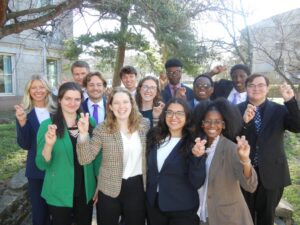
Members of TCU’s speech and debate team pose together outdoors, following a successful performance at the Pi Kappa Delta National Tournament.
TCU also made a strong impact in the debate competition. Daniel Mitchell advanced to the octofinals in varsity IPDA debate, while Casey Caldwell reached the octofinals in novice competition. Mitchell also earned a third-place speaker award, highlighting his individual performance on the national stage.
Across individual events, TCU competitors continued to stand out. Arianna LeBlanc and Ellie Griffin earned superior (top 10 percent) awards, while several team members secured excellent (top 20 percent) finishes, including Mitchell, Griffin, LeBlanc, Pelan and Tyla Robinson across multiple categories.
Together, these results marked a fitting end to a historic season – one that reflects both the strength of the program today and the legacy it carries into its second century.