
For years, students have entered Schieffer College’s department of film, television and digital media searching for careers. What they found instead were mentors.
Professor Richard Allen and associate professor of professional practice Chuck LaMendola spent their careers doing far more than teaching television writing, production and sports broadcasting. They built confidence, created opportunities and pushed students toward ambition while reminding them that success mattered most when paired with integrity, creativity and care for others.
Now, after decades of shaping generations of Horned Frogs, Allen and LaMendola are retiring together, marking the end of an era for the department and the countless students they influenced along the way.
“Some of my most dear memories as a TCU student were moments spent sitting in one of Richard Allen or Chuck LaMendola’s lectures,” Marc Istook ’98, Schieffer Board of Visitors member, said. “Their lessons of professionalism, hard work and integrity extended far beyond the classroom. But I’m even more grateful for their friendship that continues today, a testament to their impact on me and countless other Horned Frogs lucky enough to have learned from two of the best.”
Curating Creative Opportunities
For Allen, the classroom was never meant to be a place where students simply followed instructions. He wanted students to discover their own voices.
Long before creative collaboration became a common educational approach, Allen built classrooms where students learned by creating together. In the late 1990s and early 2000s, students in his television production and writing courses produced original soap operas and live studio productions while rotating through roles including directing, writing, producing, anchoring and operating technical equipment.
By the time students reached advanced productions, Allen said they no longer worked “for” him.
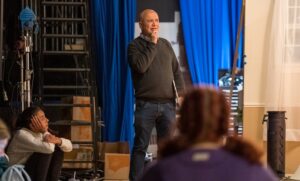
Professor Richard Allen teaches his Theory & Practice: Film Acting class
“They were so well prepared to work with me as opposed to for me or under me,” Allen said.
The productions mirrored the pace of professional environments. Students learned to meet deadlines, solve problems quickly and depend on one another while still finding room for creativity within structured formats. Allen believed that balance prepared students not only for entertainment careers but for collaboration and leadership beyond the classroom.
His philosophy centered on creative ownership. Students were encouraged to take risks, discover connections between ideas and trust their instincts.
“The most important textbook is yourself,” Allen often told students. “You’re trying to learn about yourself: What can you do? How do you do it? And how do you train yourself to adjust?”
Students remember Allen not only as a professor but as someone who made them believe they belonged in creative spaces.
“The main thing I hear students say,” Allen reflected, “is that I helped them believe in themselves.”
For Board of Visitors member Katherine Beattie ’08, that impact extended far beyond graduation.
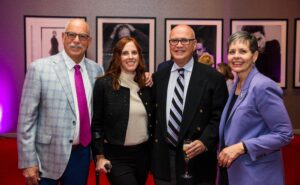
L to R: Chuck LaMendola, Katherine Beattie ’08, Richard Allen, and Dean Kristie Bunton pose together at a formal campus celebration.
“I can’t believe Richard and Chuck are retiring, but it makes sense that they would go together,” she said. “I can’t think of Texas Christian University without thinking of Richard Allen. He’s synonymous with my time at TCU, and, in the nearly 20 years since, Richard has served as a mentor, cheerleader, sounding board and eventual collaborator as we developed our own television procedural. More than anything, we’ve become friends.”
Teaching Beyond the Textbook
If Allen taught students to trust their creativity, LaMendola taught them how to enter the professional world with confidence.
Since arriving at TCU more than 30 years ago, LaMendola has built a reputation for giving students opportunities most undergraduates have never experienced.
Beginning in 1996, he mentored students directly with TCU baseball’s broadcasts on KTCU. What started as students helping with pregame and postgame coverage evolved into a pipeline of aspiring broadcasters gaining real play-by-play experience.
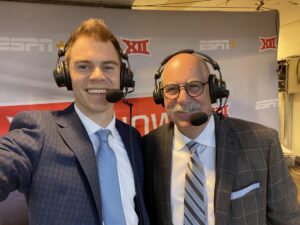
L to R: TCU Baseball alum Connor Wanhanen ’18 and Professor Chuck LaMendola call the live ESPN+ broadcast for TCU Baseball.
“If they did well, then they would do two innings of play-by-play,” LaMendola said. “And if they excelled, then they would do three innings.”
When TCU advanced to the College World Series in Omaha, Nebraska. LaMendola brought students with him. Some conducted interviews, others handled updates and pregame coverage and the most prepared students joined him on the broadcast itself.
For LaMendola, those experiences were never about prestige. They were about preparation.
“The idea was always to be able to give them opportunities to learn how to do their craft and get a chance to practice it,” he said.
Many of those students turned those experiences into professional careers in sports broadcasting and media, carrying with them the lessons LaMendola emphasized about professionalism, initiative and preparation.
But LaMendola’s influence extended beyond technical skills. He believed students needed honesty about the realities of the industry and guidance that extended beyond coursework.
“When I left college and had to go on my own, there was a steep learning curve,” he said. “I always thought, ‘I want to be honest with them and tell them not just what they need to know, but how it really functions.'”
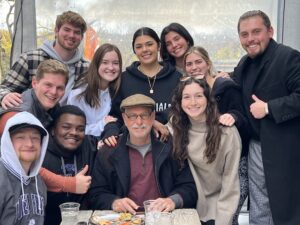
Professor Chuck LaMendola poses with students from his sports radio class (2021).
One of the clearest examples is his longtime relationship with Jean Palmer ’96, now senior manager at SportsNet New York and member of the Schieffer Board of Visitors.
“She was always conscientious,” LaMendola said. “The first to show up and the last to leave.”
After helping Palmer land opportunities working major sporting events, LaMendola encouraged her to accept a life-changing job offer in New York despite fears about leaving home.
“I said, ‘Take the job,’” he recalled. “‘If you don’t like it, you can always move back. But you’ll regret not doing it.’”
She took the chance and has built a successful career in New York. Years later, Palmer still returns to campus to speak with students, share industry advice and mentor the next generation of Horned Frogs.