

Dustin Hahn, Assistant Professor with the Department of Film, Television and Digital Media.
Why do we become fans of certain teams? It’s rarely just about the game – it’s about identity, connection and a sense of belonging.
Nowhere is this stronger than in college sports, where traditions, game-day rituals and formative life experiences create bonds and memories that last long after graduation. Schieffer College faculty expert Dustin Hahn, assistant professor with the film, television and digital media department, explains why college fandom runs deep and how it shapes both identity and community.
Why do people become fans of the teams they support in the first place?
There are many reasons for fanship, of course, but one of the most common is a strong paternal influence. If your father (or a father figure) was a strong fan of a team, there’s a high likelihood you will be too. Geographic location is another common motivation. If you have strong ties to the organization (such as you go to TCU), the organization has helped you in some way (the way the OKC Thunder helped following tornadoes in the area), or the team possesses qualities you feel represent you or what you’d like to be, such as young and fun or, of course, winners.
Individual players and celebrities can also become larger-than-life icons that people look up to or idolize, again, representing who someone feels they are or want to be.
In all of these, the biggest single driving force behind these motivations is identity. People long to feel a part of a group, like others, but also to feel separate or different, distinct from others. The psychological effects are not too dissimilar from what we might see for some other identities. Purple and horned frogs are not particularly common among college colors or mascots, so this adds to the distinctiveness of TCU.
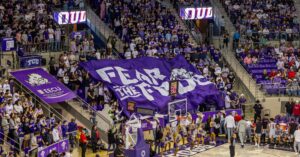
Fans unfurl a giant “Fear the Frog” flag in Schollmaier Arena.
Why do people feel such a strong emotional connection to their college teams, even years after graduating?
There are many reasons, but I will highlight two key factors as to why this is particularly true of college fanship. First, this again ties back to identity. The closer you are to the organization, the stronger your fanship may feel. When you attend a university, you spend time and money connected to the institution. You also probably suffered along the way with late nights studying, etc. But you came through it successfully in the end. Like a team that struggled for years but eventually won the championship, it just feels sweeter.
The other is that for most, college comes at a very formative time in life. You are stepping away from strong identities with family, friends and geographic locations (home) and into something that you have great ownership over now. You get to choose, and you chose TCU! The decisions you make, be it degrees, early job choices or even a potential spouse, have lifelong consequences. So, most will look back fondly at these formative years as an early fork-in-the-road of life about who they were going to become.
Of course, success on the field during their time in college can positively affect this as they associate it with this time. They will recall great, euphoric moments and associate them with the brand of their institution, which they identify with.
We all long to be a part of a “team.” And, as fans, at least in some way we are! We feel vicarious success and use “we” language when our team wins. But we also cope by saying “they lost” too. The emotional and psychological effects, both short- and long-term, are real for many types of fans.
How does college fandom help shape identity and community among students and alumni?
As noted, identity underpins much of fanship. (Social Identity Theory in particular is emphasized frequently in sports communication scholarship.) As context, fandom refers to the broader social connection of fans, whereas fanship refers more to the individual’s psychology. The fan experience during college, this unique time in one’s life, becomes highly associated with the rest of our lives, making us both a part of a group (“Go Horned Frogs!”) and distinct from others (“Boo Baylor Bears!”). The quotes here are silly, of course, but the effects on identity are real and long-lasting for most. The sense of community with others, including alumni and future Frogs, creates a commonality through shared experiences, even across generations. While many things change at TCU, certain aspects are assumed to remain – and this creates a shared identity.
Many of us have had the experience of high-fiving people we don’t know in the stands when our team has a successful moment. This is the community we feel when we identify with a team, and others connected with it, even when we know little to nothing else about them. A lot of research shows the long-term, strong, positive effects of identifying with a team. This has a way of strengthening one’s sense of self, their identity. This is true even when the success on the court (field, pitch, etc.) isn’t there. The effects of wins and losses, while strong, tend to be somewhat shorter.
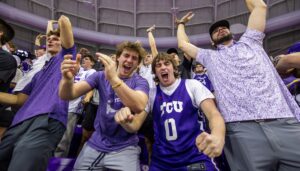
Fans cheer in Schollmaier Arena.
In what ways do traditions, rituals and game-day culture strengthen college fandom?
Traditions, rituals and game-day cultures play a part in making the collective TCU experience unique from others and giving a common experience. It becomes a lens through which we can experience the game itself. For instance, I’ve noticed that many TCU fans dress up for game day in their own urban cowboy couture, whereas Big 10 games may be filled more with students in hoodies and jeans. Many coaches will also institute traditions to create a common (to them) and unique (to others) experience that may strengthen ties to the team.
Of course, winning always helps. We all want to believe we are winners!
Why do you think college sports continue to hold such a powerful place in American culture?
Both college and sports are independently important in our society. When combined, these pivotal, formative years become intrinsically connected to the teams we root for and feel we win alongside.
College represents an opportunity to increase our chances of success in life. Sports provide a proving ground for success. And what is more American than the pursuit of success?
We all want to be winners, heroes in our own stories. There are very real psychological effects of team identification (a common type of fanship). We feel better about ourselves, more confident, more likely to believe we are capable of success in relationships, the workplace and life more broadly when our team wins. When our team loses? These beliefs fade, too. This helps explain bandwagon fans.
One of the most interesting findings to me in fanship is the observation of increased death salience following team losses. That is, the awareness of our own mortality increases when our team loses. In other words, we become more aware that we will ultimately lose in the game of life as our team loses. We don’t like thinking about this and will do what we can to avoid this, which can lead to various coping strategies.